
Black History Month happens every February in the United States. In 2027 it runs from Monday, February 1, to Sunday, February 28. Historian Carter G. Woodson started it as Negro History Week in February 1926, and he picked February because it held the birthdays of Frederick Douglass and Abraham Lincoln. College students made it a full month in 1970, and it went national in 1976.
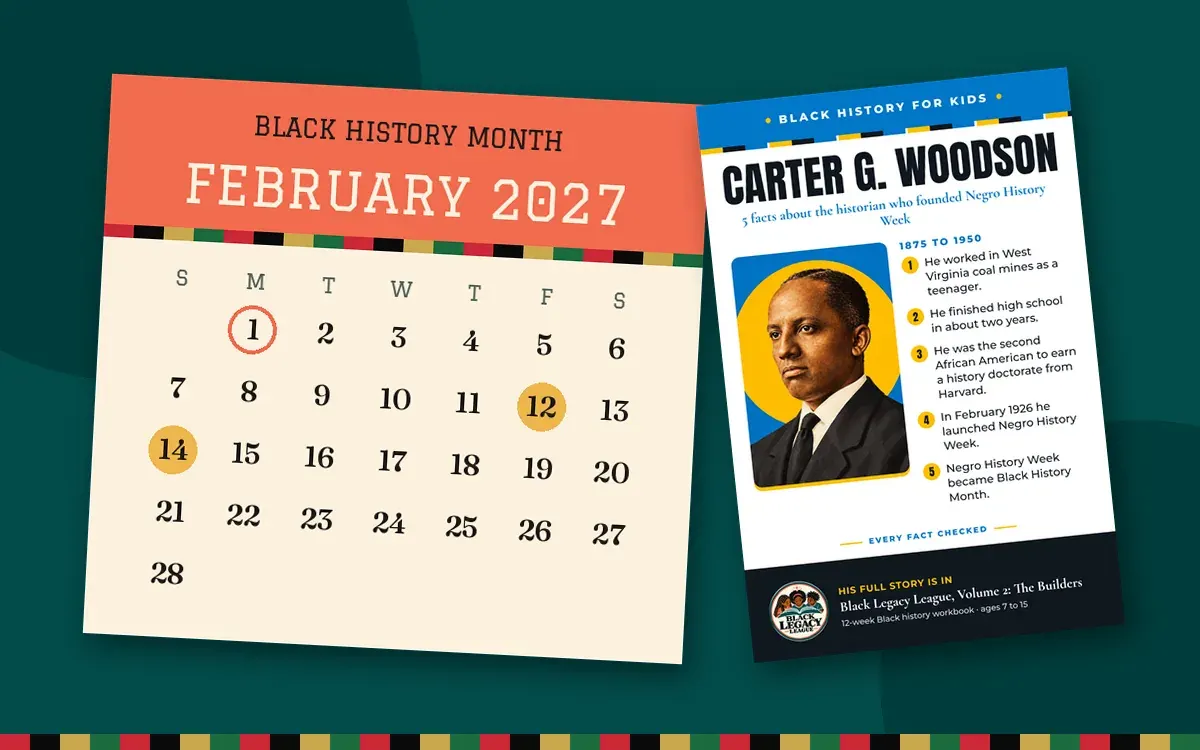
Black History Month at a glance
- When
- Every February. In 2027: Monday, February 1, to Sunday, February 28
- Who started it
- Dr. Carter G. Woodson, known as the Father of Black History
- How it began
- Negro History Week, launched in February 1926
- First full month
- Kent State University, 1970, led by Black United Students
- Went national
- 1976, when ASALH made it a month and President Gerald Ford issued the first presidential message
- Made official by Congress
- Public Law 99-244, for February 1986
- 2027 theme
- “From Black Print Culture to Digital Blackness”
- Other countries
- Canada in February; the United Kingdom in October
What is Black History Month?
Black History Month is a yearly celebration of Black people’s history, achievements and culture. Every February, schools, churches, libraries, museums and families make extra room for the stories of Black inventors, teachers, artists, scientists, athletes, builders and everyday people who shaped this country and the world.
When your kids ask what it is, try this: Black History Month is when we celebrate the people who came before us, the famous ones and the regular folks, and everything they built, made, sang, wrote and figured out.
You may also hear it called African American History Month or National African American History Month.
When is Black History Month 2027?
In the United States, Black History Month is the whole month of February. In 2027 it starts on Monday, February 1, and ends on Sunday, February 28. That’s 28 days this time, since 2027 isn’t a leap year.
Is Black History Month a federal holiday? No. It’s an observance, so schools, banks and offices stay open. You won’t find it on the federal holiday list from the U.S. Office of Personnel Management. Washington’s Birthday, the federal holiday most folks call Presidents’ Day, lands inside the month on Monday, February 15, 2027.
Planning tip: before February gets here, circle February 12 and February 14 on the family calendar. You’ll see why in a minute.
Who started Black History Month?
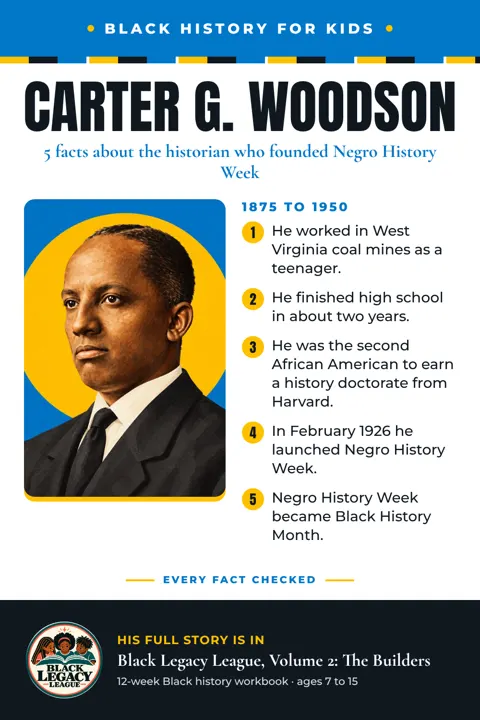
Dr. Carter G. Woodson did. People call him the Father of Black History, and he earned that title.
Woodson was born on December 19, 1875, in New Canton, Virginia. Both of his parents had been enslaved. As a teenager he worked in the West Virginia coalfields to help support his family. He didn’t start high school until he was 20, and then he finished in two years. (Tell that to the child who thinks it’s too late to start something.)
He kept going. Berea College came next, then a bachelor’s and a master’s degree from the University of Chicago, then a PhD in history from Harvard in 1912. He was the second Black American to earn a Harvard PhD, right after W.E.B. Du Bois.
Woodson knew our history ran deep, and he knew most schools weren’t teaching it. In the summer of 1915, he traveled to Chicago for a celebration marking 50 years since emancipation. Thousands came to see the exhibits. Before he left town, he met with four friends at the Wabash YMCA, and on September 9 they started the Association for the Study of Negro Life and History. Today it’s called ASALH, the Association for the Study of African American Life and History, and it still sets the national theme every year.
In 1916 he started The Journal of Negro History, which gave scholars a home for the research. Woodson wanted regular families to have it too. So in February 1926, he announced Negro History Week.
Why is Black History Month in February?
Two birthdays: Abraham Lincoln on February 12 and Frederick Douglass on February 14.
Black communities were already celebrating both. They had honored Lincoln since his assassination in 1865 and Douglass since the late 1890s. Woodson set his week right where our folks were already gathering. He met people where they were.
He also wanted the week to be bigger than two famous men. ASALH explains that Woodson wanted the spotlight on Black people as a whole, including the Black soldiers who fought for the Union and helped end slavery.
Here’s some Douglass trivia the kids will love. Like most people born into slavery, Douglass was never told the day he was born. So he chose February 14 for himself. He remembered that his mother called him her “Little Valentine.”
Myth check
Is Black History Month in February because it’s the shortest month? No. Woodson chose a week in February back in 1926 because of those two birthdays. The national month came 50 years later and grew right out of that week.
The history of Black History Month, year by year
A week in 1926 grew into a month that schools, churches and families across the country now plan for all year. Here’s how it happened.
- 1915
Woodson and four friends start the Association for the Study of Negro Life and History at the Wabash YMCA in Chicago on September 9.
- 1916
Woodson launches The Journal of Negro History, so scholars finally have a home for Black history research.
- 1924
His fraternity brothers in Omega Psi Phi create Negro History and Literature Week.
- 1926
Negro History Week begins in February. The Association sends out pictures, lessons, plays and posters, and schools start Negro History Clubs.
- 1937
At Mary McLeod Bethune’s urging, Woodson starts the Negro History Bulletin, built around each year’s theme.
- 1940s
Black West Virginians start celebrating all of February as Negro History Month.
- 1950
Woodson dies on April 3 at his office and home in Washington, D.C.
- 1970
Black United Students at Kent State University hold the first month-long Black History Month.
- 1976
ASALH makes it a month nationwide. On February 10, President Gerald Ford becomes the first president to recognize it.
- 1986
Congress passes Public Law 99-244, naming February 1986 National Black (Afro-American) History Month.
- 2006
Woodson’s home in Washington, D.C., becomes part of the National Park System.
- 2026
The country marks 100 years of national Black history celebrations.
- 2027
The theme is “From Black Print Culture to Digital Blackness.”
Woodson’s week caught on fast. Mayors issued proclamations, and communities put on plays, pageants, speeches, essay contests and concerts. The Association could barely keep up with requests for materials. It all came from people, long before any president or Congress said a word.
Why do we celebrate Black History Month?
So our kids know where they come from, and so everybody else gets the whole story of this country.
Woodson believed people draw strength from knowing what their ancestors accomplished. He also never meant for Black history to fit inside one week. He pushed schools to keep teaching it all year and talked about growing a Negro History Week into a Negro History Year. ASALH says he looked forward to a time when the annual celebration would no longer be necessary.
That’s why we keep it going past February. A month gives your family a running start. The other eleven months are where the learning sticks.
Want the research behind it? Read why Black history is important for kids.
When your child asks
“Why isn’t there a White History Month?” Kids ask this one, so have an answer ready. Here’s how we answer it: most history lessons already center white Americans. Black History Month adds the stories that got skipped, so the whole picture finally shows up. Everybody benefits from the full story.
What is the 2027 Black History Month theme?
Every year ASALH picks a theme, a tradition that started with Woodson himself. The 2027 theme is “From Black Print Culture to Digital Blackness.” It looks at print and digital media as tools Black people have used to tell our own stories and build power, and as tools that can also be turned against us.
Kid version: Black people have always made our own newspapers, books and magazines, and now we make websites, videos and podcasts too. It’s about telling our story in our own words.
Want a perfect starting point? In 1827, Samuel Cornish and John Brown Russwurm started Freedom’s Journal in New York, the first African American owned and operated newspaper. In their first issue they wrote, “Too long have others spoken for us.”
Try this at home: make a one-page family newspaper with a headline, a story about a grandparent and a drawing. Then make a digital version, like a short video or a slideshow. Talk about which one felt more like your family’s voice.
What are the Black History Month colors?
The colors you’ll see most are red, black and green. They come from the Pan-African flag, which Marcus Garvey’s Universal Negro Improvement Association adopted in August 1920 at its convention in New York. Plenty of families add gold too.
Let the kids help decorate, then ask them what each color means to your family. Write their answers on a sticky note and keep it up all month.
Is Black History Month celebrated in other countries?
Yes. Canada celebrates in February. In 1995, the House of Commons officially recognized February as Black History Month after a motion by Jean Augustine, the first Black woman elected to Canada’s Parliament, and the Senate followed in 2008.
The United Kingdom celebrates in October. Its first Black History Month took place in 1987, organized by Akyaaba Addai-Sebo, a Ghanaian-born special projects officer at the Greater London Council.
Same idea, different calendars. Our history doesn’t stop at any border.
How to explain Black History Month to kids, by age
Start with one honest sentence and one good question. Pick the card that fits your child.
Ages 3 to 5
Little ones
Say it like this“This month we celebrate Black people who did amazing things. It’s like a birthday party for our history, and it lasts the whole month.”
Pick one person a week. Look at their picture, sing a song, color a page. Repeat the same name all week, because little ones love repeats.
Ages 6 to 8
Early readers
Say it like this“A long time ago, most schools didn’t teach Black history. A teacher named Dr. Carter G. Woodson started a special week so everybody could learn it. That week grew into a whole month.”
Ask, “Who would you add to the history books?” Let them draw that person and tell you why.
Ages 9 to 12
Big kids
Say it like this“Black history is American history and world history too. Woodson picked February because Black families already celebrated Frederick Douglass’s birthday that week. He built on something our people were already doing.”
Ask, “Why do you think so many schools left these stories out?” Then let them find one story that surprised them.
Ages 13 and up
Teens
Say it like this“Woodson said he looked forward to the day an annual celebration would no longer be necessary. Are we there yet? What would have to change?”
Let them argue it out. Teens remember the conversations where their opinion counted.
Black History Month facts for kids
Read one a day at breakfast. Ten facts carry you through the school days of the first two weeks.
It started as one week in February 1926, so 2026 marked 100 years of national Black history celebrations.
Carter G. Woodson didn’t start high school until he was 20. He finished in two years.
In 1912, Woodson became the second Black American to earn a PhD from Harvard, after W.E.B. Du Bois.
Frederick Douglass never knew his real birthday, so he picked February 14 himself.
College students planned the first month-long celebration, at Kent State University in 1970.
President Gerald Ford was the first president to recognize Black History Month, on February 10, 1976.
Every year gets a theme. The 2027 theme is “From Black Print Culture to Digital Blackness.”
Woodson’s home in Washington, D.C., is now a National Historic Site run by the National Park Service.
The first Black-owned newspaper in the United States, Freedom’s Journal, started in New York in 1827.
Canada celebrates Black History Month in February too. The United Kingdom celebrates in October.
Want more? Our 30 fun, little-known Black history facts for kids picks up where this list stops.
Make February count
Pick what fits your family’s week. Our Black History Month activities by age covers toddlers through middle schoolers. Our 25 sourced trivia questions make a fun family game night. And Woodson’s full story lives in Volume 2 of our Black history workbooks, The Builders.
Try a full week free
Get Week 1 of Volume 2: 16 print-ready pages with three reading levels and an answer key, for ages 7 to 15.
Get Week 1 freePlan the whole year
Five workbooks, 12 weeks each, so February is only the beginning. Every volume comes as a printable PDF or a full-color paperback.
Compare the workbooksStart with the Volume 1 paperback on Amazon ↗
Black History Month questions parents ask
When is Black History Month 2027?
Black History Month 2027 runs from Monday, February 1, to Sunday, February 28, 2027. In the United States it takes up the whole month of February every year.
Who started Black History Month?
Historian Dr. Carter G. Woodson started it. He founded the Association for the Study of Negro Life and History, now ASALH, in 1915 and launched Negro History Week in February 1926. That week grew into Black History Month.
Why is Black History Month in February?
Woodson chose February because it held the birthdays of Abraham Lincoln on February 12 and Frederick Douglass on February 14, which Black communities already celebrated.
Is Black History Month in February because it is the shortest month?
No. Woodson picked a week in February in 1926 because of the Lincoln and Douglass birthdays. The national month came in 1976 and grew out of that week.
When did Black History Month become official?
Black United Students held the first month-long celebration at Kent State University in 1970. ASALH made it a national month in 1976, when President Gerald Ford issued the first presidential message. Congress passed Public Law 99-244 for February 1986.
What is the Black History Month theme for 2027?
The 2027 theme, chosen by ASALH, is “From Black Print Culture to Digital Blackness.” It looks at how Black people have used print and digital media to tell their own stories.
Is Black History Month a federal holiday?
No. Black History Month is an observance, so schools and offices stay open. It is not on the federal holiday list from the U.S. Office of Personnel Management.
What are the Black History Month colors?
The most common colors are red, black and green, from the Pan-African flag adopted by Marcus Garvey’s UNIA in 1920. Many families add gold.
When is Black History Month in Canada and the UK?
Canada celebrates Black History Month in February. The United Kingdom celebrates it in October.
How do I explain Black History Month to a child?
Keep it simple: it’s a month to celebrate Black people who did amazing things and the everyday people who came before us. Share one person a week, then ask your child who they would add to the history books.
Sources
- Origins of Black History Month, ASALH
- 2027 Black History Theme Executive Summary, ASALH
- Black History Themes, ASALH
- Carter G. Woodson, National Park Service
- Carter G. Woodson Home National Historic Site, National Park Service
- It Started Here: Kent State to Celebrate 55th Anniversary of Black History Month, Kent State University
- Recognition of Black History Month, Gerald R. Ford Presidential Library
- Public Law 99-244 (1986), U.S. Congress
- Federal Holidays, U.S. Office of Personnel Management
- Remembering Frederick Douglass on his 200th birthday, University of Rochester
- Frederick Douglass birthday celebration, AFRO American Newspapers
- Honoring African American Contributions: The Newspapers, Library of Congress
- The Red, Black and Green Flag, HowStuffWorks
- About Black History Month, Government of Canada
- How Black History Month began, The Week
- National African American History Month Speech Resources: Fact Sheet, Congressional Research Service
The age scripts, activities and discussion questions are our own.